
Mold machining for aluminum die-casting is the process of fabricating the metal mold used to cast aluminum components to a technical drawing. Daiwa provides a full-package mold machining service, from design through to a finished mold, meeting mass-production requirements with high precision and long mold life.
Context: Why the mold determines the success of the entire production project
In the aluminum die-casting production chain, the mold acts as the master reference that determines the shape, precision, and surface quality of every product cast from it afterward. A mold designed and machined to the correct technical standard will produce tens of thousands of consistent parts. Conversely, a mold with a flaw from the outset will cause the same defect to repeat across the entire batch, no matter how skilled the casting machine operators are.
For this reason, many businesses launching a new production project run into one of two risky situations:
- Choosing a mold maker based on the lowest price alone, resulting in a mold with a short lifespan, unstable tolerances, or one that needs repeated repair during production.
- Separating mold design from the actual casting process, causing the mold to be poorly optimized for the pressure die-casting technology that will actually be used, leading to a high defect rate during trial runs.
Both situations create hidden costs: project delays, mold repair expenses, and the risk of late delivery to the end customer. For this reason, choosing a mold maker with solid technical capability and a real understanding of the casting technology is a step just as important as choosing the die-casting supplier itself.
Comparing a properly machined mold with a poorly made one
The table below illustrates the difference between a mold machined to the correct technical standard and a poorly made one, helping businesses better understand the real value of a professional mold machining service.
| Criteria | Poorly machined mold | Mold to proper technical standard |
|---|---|---|
| Mold lifespan | Degrades quickly, needs early repair after a few thousand cycles | Maintains precision over tens of thousands of casting cycles |
| Product defect rate | High, prone to porosity, warping, dimensional deviation | Low and stable across production batches |
| Compatibility with casting technology | May not be optimized for pressure die-casting, causing difficult mold release | Designed in sync with the casting technology actually used |
| Additional costs incurred | High, due to repeated mold repair or rework | Lower, thanks to stability from the trial-run stage onward |
| Project timeline | Delayed due to defects that need fixing | On schedule, thanks to thorough inspection before handover |
This comparison shows that a mold’s low upfront cost does not always mean a low total cost throughout production. This is why businesses should evaluate mold-making capability comprehensively, not just on the quoted price.
Daiwa’s full-package aluminum die-casting mold service
Daiwa provides mold machining as a closed-loop service, from design through to trial runs, giving customers control over mold quality throughout the process rather than simply receiving the finished mold at the end.
01
Mold design and DFM consulting
Engineers analyze the product drawing and determine the mold structure suited to the shape and technical requirements, while also advising on DFM to catch early design points that could cause casting difficulties — such as walls that are too thin, unsuitable fillet radii, or geometry that is hard to release from the mold.
02
Selecting the right mold material
Mold material is chosen based on the expected production volume, product shape, and mold-life requirements. SKD61 tool steel is typically preferred for large-volume orders thanks to its heat and wear resistance, while other materials may better suit smaller orders or prototype runs.
03
Precision machining
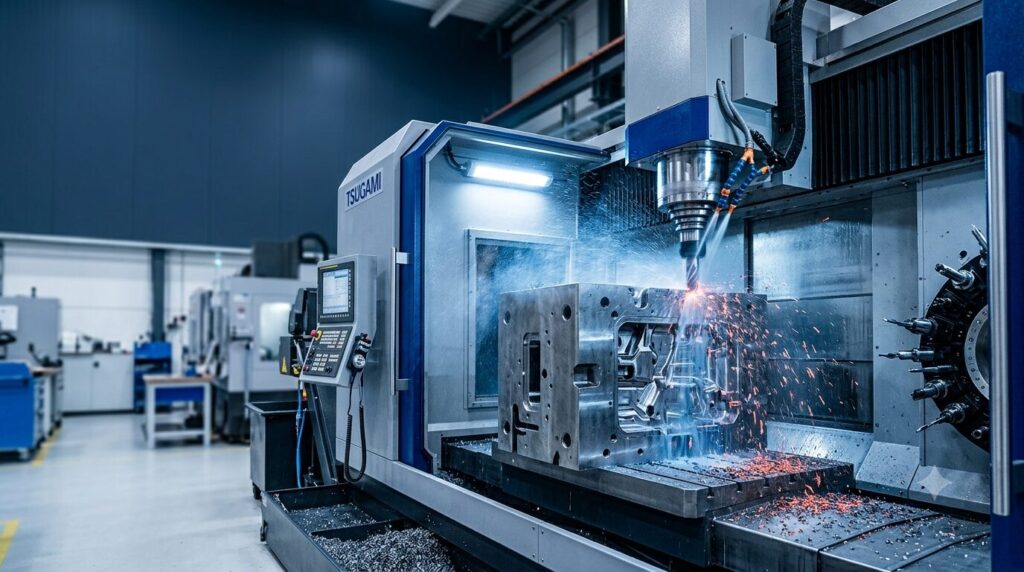
The mold is machined on high-precision CNC equipment to meet the tolerances on the design drawing — the stage that determines the mold’s geometric accuracy, which directly affects the dimensions and surface quality of the cast product later on.
04
Mold inspection before trial run
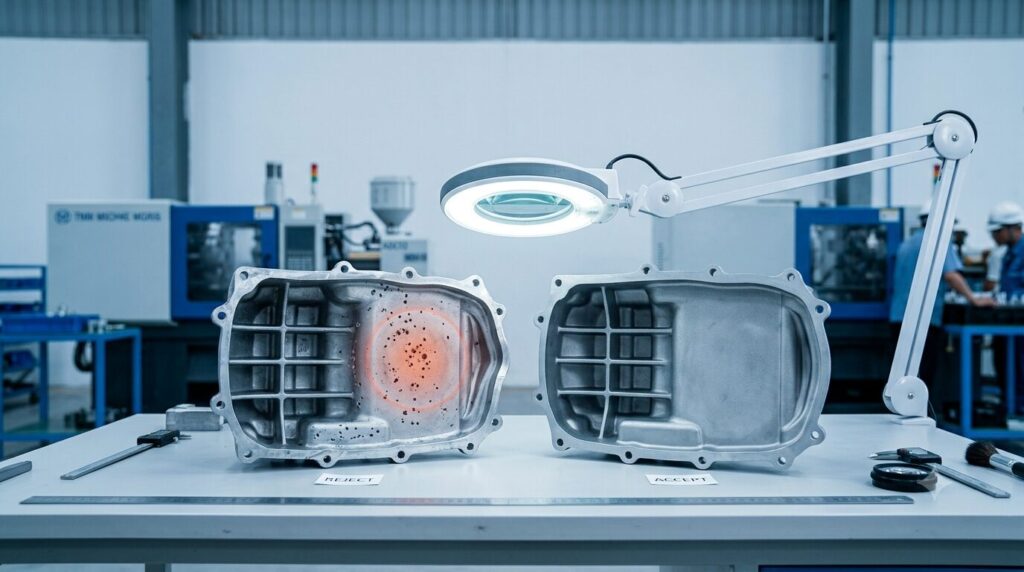
After machining, the mold’s dimensions and surface are inspected with precision measuring equipment and compared against the original design tolerances, catching any deviation before the mold goes into an actual trial run.
05
Trial run and adjustment before mass production
The mold is trial-run to test its ability to form the actual product under real pressure die-casting conditions. If deviations in fill, shrinkage, or surface quality are found, the technical team adjusts the mold before moving on to large-volume production.
Criteria for evaluating an aluminum die-casting mold supplier
When choosing a mold maker, businesses should evaluate on more than price alone. The table below summarizes the most important criteria.
| Criteria | Why it matters | Question to ask the supplier |
|---|---|---|
| Design capability and DFM consulting | Reduces the risk of design flaws before the real mold is made | Does the supplier advise on design optimization before making the mold? |
| Precision CNC machining equipment | Ensures mold tolerances meet technical requirements | Does the CNC equipment achieve the precision your product needs? |
| Mold quality inspection system | Catches deviations early, before mass production | Is the mold measured with dedicated equipment before the trial run? |
| Trial run and adjustment process | Reduces the defect rate when moving to mass production | Does the supplier run a full trial before handover? |
| Experience serving FDI clients | Understands international standards and working procedures | Has the supplier machined molds for a similar product category before? |
Risks of choosing the wrong mold maker, and how to manage them
Choosing the wrong mold maker doesn’t just affect a single batch — it can affect the entire project timeline.
Risk of a mold not optimized for the actual casting technology
If the mold maker lacks hands-on experience with pressure die-casting, the mold may be designed in theory but run into trouble during the actual trial. It’s best to choose a supplier that handles both mold machining and casting, or one that at least has experience working closely with a casting partner.
Risk of unexpected mold repair costs
If the mold isn’t thoroughly inspected before the trial run, defects may only surface after some quantity of product has already been made. Ask the supplier to provide a mold inspection report before confirming the official trial run.
Risk of delays from lacking integrated machining capability
If the mold maker has to outsource part of the process, coordination time between parties can extend the project timeline. Prioritize a supplier with complete equipment and machining capability at a single location.
Checklist for evaluating a mold maker before choosing one
- Does the supplier advise on DFM before finalizing the mold design?
- Is the proposed mold material suited to the expected production volume?
- Is the mold’s dimensions inspected with dedicated equipment before the trial run?
- Does the supplier run a full trial and adjustment before handover?
- Does the supplier have integrated machining capability at one site, or must it coordinate across multiple parties?
Applications of aluminum die-casting mold services by industry
Aluminum die-casting mold services serve many different manufacturing industries, each with its own requirements for precision and mold life.
Automotive and motorcycles
Parts such as engine housings and brackets are typically produced in large volumes over long periods, requiring molds with high durability and stable precision across tens of thousands of casting cycles.
Industrial equipment and automation
Components in this industry often have complex geometry, requiring the mold to be optimized from the outset to avoid features that are hard to release or prone to warping.
Electrical and electronics
Products in this industry often have thin walls and tight tolerances, requiring the mold to be machined with high precision to ensure proper heat dissipation and accurate assembly.
Medical devices
This application group requires especially strict quality standards. Molds for this industry need thorough inspection and complete quality records, and ideally involve a dedicated QA/QC department in the evaluation.
Frequently asked questions
Does Daiwa machine molds from a customer’s existing drawing?
Yes. The technical team will review the drawing and advise on adjustments if needed to ensure manufacturability, before proceeding with the official mold machining.
Which mold material is suited to large-volume production?
Material selection depends on the expected volume, product shape, and mold-life requirements. The technical team will advise specifically after reviewing each project’s actual requirements.
Do the mold and the casting need to be done at the same place?
It’s not mandatory, but doing both at the same supplier reduces the risk of discrepancies between the mold and the actual casting process, and shortens coordination time whenever adjustments are needed.
If a defect is found during the mold trial run, how is it handled?
The technical team analyzes the cause, adjusts the mold, and re-runs the trial before confirming the move to mass production. It’s best to agree in advance with the supplier on the process and turnaround time for handling any issues.
How long does it take to machine an aluminum die-casting mold?
Machining time depends on the product’s complexity, the mold’s size, and the material used. The technical team will provide a specific timeline after reviewing the drawing.
Get advice on aluminum die-casting mold machining
If you need advice on designing and machining a mold for a new production project, Daiwa’s technical team is ready to help review your drawing and propose the right material and machining approach for your specific requirements.
This article is for technical reference, please contact Daiwa Light Alloy Industry Vietnam directly for advice tailored to your specific requirements.